Complete Guide to Lathe Machine Parts and Their Functions
A lathe machine is one of the most important machines used in the manufacturing and metalworking industry. It is designed to rotate a workpiece while a cutting tool removes material to create the required shape, size, and finish. From small workshops to large industrial production units, lathe machines are widely used for turning, facing, threading, drilling, boring, and several other machining operations.
Understanding the different lathe machine parts and their functions is essential for operators, engineers, students, and manufacturers. Each component has a specific role, and the combined performance of these parts determines the accuracy, productivity, and durability of the machine.
What Is a Lathe Machine?
A lathe machine is a machine tool in which the workpiece rotates around its axis while a cutting tool moves against it. Depending on the type and configuration of the machine, it can be used for machining materials such as steel, cast iron, aluminium, brass, stainless steel, and engineering plastics.
The basic principle is simple: the workpiece is securely held and rotated by the spindle, while the cutting tool is positioned and moved along the workpiece to remove material.
Main Parts of a Lathe Machine
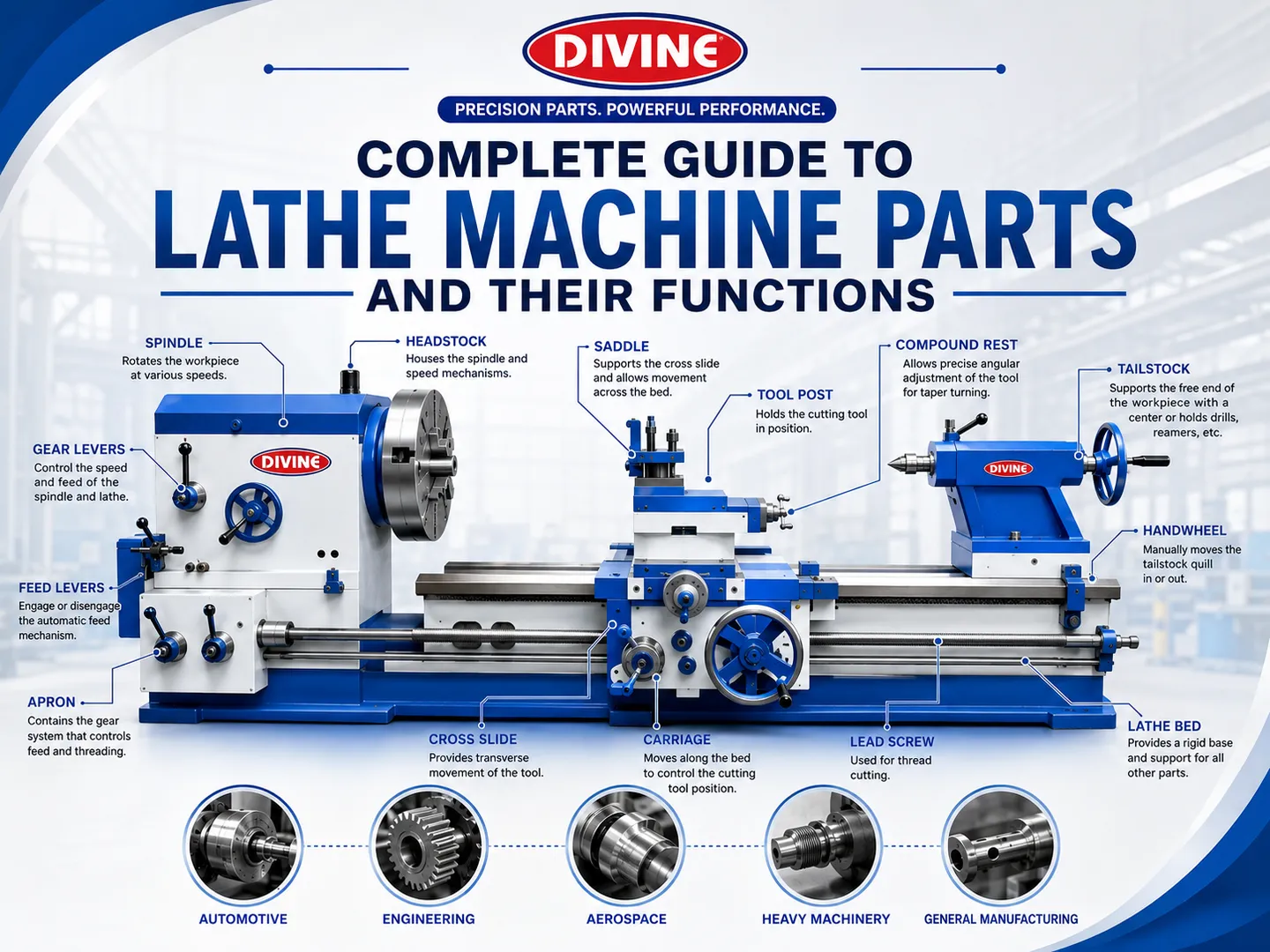
A conventional lathe consists of several important components. The major parts include:
- Bed
- Headstock
- Tailstock
- Carriage
- Cross slide
- Compound rest
- Tool post
- Lead screw
- Feed rod
- Apron
- Chuck
- Spindle
- Gears and gearbox
Let us understand the function of each component in detail.
1. Lathe Machine Bed
The bed is the strong foundation of the lathe machine. It supports and aligns the major components, including the headstock, tailstock, and carriage.
Usually manufactured from rigid cast iron or other suitable materials, the bed is designed to resist vibration and maintain dimensional accuracy during machining.
Function of the Bed
The main functions of the lathe bed are:
- Supporting major machine components
- Maintaining proper alignment
- Providing guideways for carriage movement
- Reducing vibration during machining
- Maintaining machine rigidity
A properly designed bed is essential for achieving consistent machining accuracy.
2. Headstock
The headstock is located at one end of the lathe bed. It contains the main spindle, bearings, gears, and other drive mechanisms responsible for rotating the workpiece.
The spindle receives power from the motor through the drive system and transfers rotational motion to the work-holding device.
Function of the Headstock
The headstock:
- Houses the main spindle
- Provides rotational power
- Supports the chuck or faceplate
- Controls spindle speed
- Contains gears or speed-control mechanisms
The performance of the headstock directly affects the machine's cutting capability and surface finish.
3. Lathe Machine Spindle
The spindle is a rotating shaft positioned inside the headstock. It is one of the most critical components of a lathe because the workpiece or chuck is mounted on it.
The spindle must have sufficient strength and rigidity to handle cutting forces while maintaining accurate rotation.
Spindle Functions
- Rotates the workpiece
- Holds the chuck or other work-holding equipment
- Transfers power from the drive system
- Maintains rotational accuracy
4. Lathe Chuck
A chuck is a work-holding device mounted on the spindle. It grips the workpiece firmly during machining.
Different types of chucks are available, including:
- Three-jaw chuck
- Four-jaw chuck
- Collet chuck
- Magnetic chuck
- Special-purpose chucks
A three-jaw chuck is commonly used when quick and concentric work holding is required, while a four-jaw chuck provides greater flexibility for irregular or independently adjusted workpieces.
5. Tailstock
The tailstock is positioned on the opposite side of the headstock. It can slide along the lathe bed and be locked at the required position.
It is commonly used to support the free end of a long workpiece or to hold tools such as drills, reamers, and countersinks.
Function of Tailstock
The tailstock is used for:
- Supporting long workpieces
- Holding drilling tools
- Performing reaming operations
- Supporting centres
- Improving machining stability
6. Carriage
The carriage is responsible for supporting and moving the cutting tool along the workpiece. It travels on the guideways of the lathe bed.
The carriage assembly generally consists of the saddle, cross slide, compound rest, tool post, and apron.
Function of the Carriage
- Supports the cutting tool
- Controls tool movement
- Provides longitudinal and cross movement
- Helps maintain controlled cutting depth
7. Saddle
The saddle is the lower section of the carriage. It rests directly on the lathe bed and moves along the guideways.
It provides the foundation for mounting the cross slide and other carriage components.
8. Cross Slide
The cross slide is mounted on the saddle and moves perpendicular to the spindle axis.
This movement allows the cutting tool to move toward or away from the rotating workpiece.
Cross Slide Functions
- Controls cutting depth
- Provides transverse tool movement
- Supports the compound rest
- Helps produce accurate diameters
9. Compound Rest
The compound rest is positioned above the cross slide. It can normally be rotated to different angles, making it useful for angular turning and taper machining.
Uses of Compound Rest
It is commonly used for:
- Taper turning
- Short-angle machining
- Fine tool positioning
- Thread-related operations
- Controlled manual cutting
10. Tool Post
The tool post holds the cutting tool securely in the required position. It is mounted on the compound rest.
Different tool posts are available, including single-tool, four-way, quick-change, and other specialized designs.
A rigid tool post helps reduce tool movement and contributes to better machining accuracy.
11. Apron
The apron is attached to the front portion of the carriage. It contains mechanisms that control carriage movement and feed operations.
It includes various gears, clutches, levers, and other mechanisms depending on the machine design.
Function of the Apron
The apron helps:
- Control carriage movement
- Provide automatic feed
- Engage feed mechanisms
- Support carriage-control components
12. Lead Screw
The lathe machine lead screw is a precision threaded shaft positioned along the front of the machine bed.
It is particularly important for thread cutting. When the lead screw rotates in synchronization with the spindle, the carriage moves at a controlled rate to generate the required thread pitch.
Lead Screw Functions
- Produces screw threads
- Synchronizes carriage movement with spindle rotation
- Provides precise longitudinal movement
- Supports threading operations
The quality, accuracy, and surface finish of a lead screw are important factors in reliable threading performance.
13. Feed Rod
The feed rod is used to transmit power for automatic carriage and cross-slide movement during regular turning operations.
Unlike the lead screw, the feed rod is generally used for power feed rather than conventional thread generation.
Feed Rod Functions
- Provides automatic feed
- Transfers rotational power
- Controls carriage movement
- Supports consistent machining operations
14. Lathe Machine Gearbox
Many lathes include a gearbox or quick-change gearbox to control feed rates and thread pitches.
The gearbox allows operators to select appropriate settings according to the machining requirement.
Main Functions
- Selecting thread pitches
- Controlling feed rates
- Transmitting mechanical power
- Improving machining flexibility
15. Guideways
Guideways are precision surfaces machined into the lathe bed. They guide the carriage and tailstock during movement.
Accurate guideways are essential because even small alignment errors can affect machining dimensions and surface quality.
16. Motor and Drive System
The motor provides the power required to rotate the spindle and operate the machine's mechanical systems.
Depending on the lathe design, power can be transferred through belts, pulleys, gears, or other drive mechanisms.
Functions
- Supplies machine power
- Drives spindle rotation
- Enables different operating speeds
- Supports continuous machining
Types of Lathe Machine Parts
Lathe components can broadly be classified according to their purpose.
Work-Holding Components
These components secure the workpiece during machining.
Examples include:
- Chucks
- Faceplates
- Centres
- Collets
- Mandrels
Tool-Support Components
These components hold and position the cutting tool.
Examples include:
- Tool post
- Compound rest
- Cross slide
- Carriage
Power-Transmission Components
These components transfer power and control movement.
Examples include:
- Spindle
- Gears
- Gearbox
- Lead screw
- Feed rod
Why Quality Lathe Machine Parts Matter
The quality of individual components has a direct impact on overall machine performance. Precision-made parts can help improve dimensional accuracy, reduce vibration, extend machine life, and maintain consistent production.
For manufacturers and machine users, important factors include:
- Material quality
- Dimensional accuracy
- Surface finish
- Proper heat treatment
- Component alignment
- Wear resistance
- Manufacturing consistency
A high-quality lathe machine spare parts manufacturer can therefore play an important role in maintaining the reliability of both new and existing machines.
Common Lathe Machine Operations
Understanding machine components becomes easier when you know the operations they support.
Turning
Turning removes material from the outer diameter of a rotating workpiece to produce a cylindrical surface.
Facing
Facing produces a flat surface at the end of the workpiece.
Threading
Threading creates internal or external screw threads using a synchronized tool movement.
Drilling
Drilling creates a hole in the workpiece, generally using a drill mounted in the tailstock.
Boring
Boring enlarges or improves an existing hole.
Knurling
Knurling produces a patterned surface for improved grip or appearance.
Taper Turning
Taper turning creates a gradually changing diameter along the length of a workpiece.
How to Select Reliable Lathe Machine Components
When purchasing replacement or newly manufactured components, buyers should consider more than price. Component accuracy, material, compatibility, and manufacturing quality are equally important.
Before ordering, check:
- Required dimensions
- Machine model and specifications
- Material grade
- Thread specifications
- Surface finish
- Heat-treatment requirements
- Tolerance requirements
- Manufacturer's production capability
Working with an experienced manufacturer can also help ensure that customized components match the machine's original specifications.
Maintenance Tips for Lathe Machine Parts
Regular maintenance can significantly improve the working life of lathe components.
Keep Guideways Clean
Remove chips, dust, and other contaminants from guideways regularly.
Lubricate Moving Components
Use the recommended lubricant for bearings, gears, lead screws, and other moving parts.
Inspect the Lead Screw
Check the lead screw for excessive wear, thread damage, backlash, or unusual movement.
Check the Chuck
Ensure the chuck operates smoothly and grips the workpiece securely.
Monitor Vibration
Unexpected vibration may indicate problems with alignment, bearings, work holding, tooling, or machine components.
Inspect Fasteners
Loose bolts and fittings can affect machine stability and accuracy.
Conclusion
Every component of a lathe machine contributes to its overall performance. From the bed that provides structural support to the spindle that rotates the workpiece and the lead screw that enables accurate threading, each part has a specific and important function.
Understanding lathe machine parts and their functions helps operators use equipment correctly, assists engineers in selecting suitable components, and enables manufacturers to produce accurate replacement parts.
For industrial applications, choosing precisely manufactured components and following a proper maintenance routine can improve machining accuracy, productivity, and machine service life.
SEO Keywords
Primary Keywords:
- Lathe machine parts
- Lathe machine parts and functions
- Parts of lathe machine
- Lathe machine components
- Lathe machine parts manufacturer
Secondary Keywords:
- Lathe machine spare parts
- Lathe machine lead screw
- Lathe machine spindle
- Lathe machine chuck
- Lathe machine carriage
- Lathe machine tailstock
- Lathe machine bed
- Lathe machine tool post
- Lathe machine gearbox
- Industrial lathe machine parts
Keywords