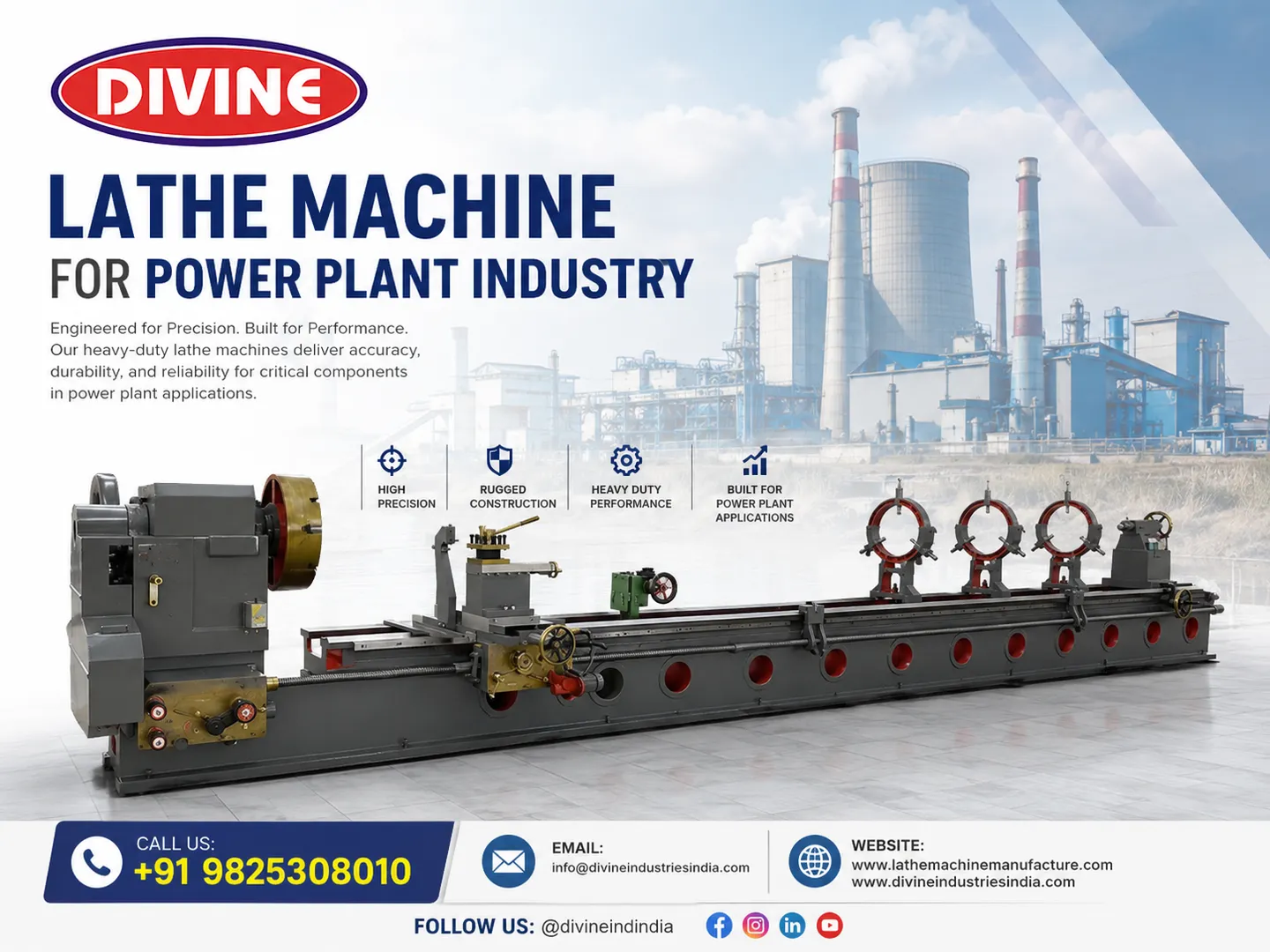
Lathe Machine for Power Plant Industry: Precision Machining for Reliable Power Generation
The power plant industry depends on high-performance equipment, precision components, and reliable maintenance systems to ensure uninterrupted power generation. From turbines and generators to shafts, bushings, flanges, and large cylindrical components, many critical parts require accurate machining during manufacturing, repair, and maintenance.
A lathe machine for the power plant industry plays an important role in achieving the required dimensional accuracy, surface finish, and component reliability. Modern industrial lathes are designed to handle demanding machining applications and can be used for both new component production and maintenance work.
What Is a Lathe Machine?
A lathe machine is an industrial machine tool used to remove material from a rotating workpiece with the help of cutting tools. The workpiece rotates around its axis while the cutting tool moves along or across it to achieve the required shape and dimensions.
Depending on the application, lathe machines can perform operations such as:
- Turning
- Facing
- Thread cutting
- Boring
- Drilling
- Grooving
- Knurling
- Taper turning
- Parting
- Surface finishing
For power plant applications, these operations are essential for producing and maintaining components that require dependable performance under demanding operating conditions.
Importance of Lathe Machines in Power Plants
Power generation equipment operates under significant mechanical and thermal loads. Even a small dimensional error in a critical component can affect equipment performance, alignment, vibration, or service life.
Industrial lathe machines help manufacturers and maintenance teams achieve consistent machining accuracy. They are particularly useful for components with cylindrical, conical, threaded, or symmetrical profiles.
A suitable lathe machine can help with:
High dimensional accuracy: Precise machining helps components meet specified dimensions and tolerances.
Better surface finish: Proper cutting conditions can produce smooth surfaces required for assemblies and rotating components.
Component repair: Damaged or worn components can often be re-machined instead of completely replaced.
Reduced maintenance downtime: In-house or nearby machining capabilities can help speed up repair and maintenance activities.
Repeatable production: Industrial machines can produce multiple components with consistent dimensions.
Power Plant Components Machined on Lathe Machines
Lathe machines can be used for manufacturing, repair, and maintenance of various power plant components. Typical applications include:
1. Turbine Shafts
Turbine shafts require accurate machining because they operate at high rotational speeds. Turning and finishing operations can help achieve the required diameter, concentricity, and surface quality.
2. Generator Components
Generators contain several precision components that may require turning, boring, facing, or other machining processes during manufacturing and maintenance.
3. Bushes and Sleeves
Bushes, sleeves, and cylindrical wear components can be produced efficiently on a lathe. Accurate internal and external diameters are important for proper assembly and operation.
4. Flanges
Industrial lathes can be used for machining certain types of flanges, including facing and boring operations where appropriate.
5. Couplings
Couplings used in rotating equipment require accurate dimensions and alignment. Lathe machining can be used for producing and reconditioning coupling components.
6. Pins and Rollers
Various pins, rollers, and cylindrical components used in power plant equipment can be manufactured using turning operations.
7. Pump and Valve Components
Power plants use numerous pumps and valves. Components such as shafts, sleeves, stems, and other cylindrical parts can require lathe machining during manufacturing or repair.
Key Features to Consider When Selecting a Lathe Machine for Power Plant Applications
Choosing the right lathe machine depends on the size, material, tolerance, and complexity of the components being machined.
Important factors include:
Machine Capacity
The swing over bed, distance between centers, and maximum workpiece weight should match the components commonly handled by the power plant or engineering workshop.
Spindle Power
Adequate spindle power is important when machining tough materials or large components. Higher power can support demanding cutting operations when matched with suitable tooling and cutting parameters.
Rigidity
A rigid machine structure helps minimize vibration and deflection, particularly when machining large or heavy components.
Precision
Power plant components often require controlled dimensions and alignment. Machine accuracy and repeatability should therefore be considered carefully.
Heavy-Duty Construction
For industrial maintenance and manufacturing, a robust machine construction can provide reliable performance under continuous or demanding working conditions.
Tooling Compatibility
The availability of suitable cutting tools, tool holders, boring bars, and other accessories can significantly affect machining productivity.
Advantages of Using Industrial Lathe Machines in Power Plant Maintenance
A reliable lathe machine can provide several benefits to power generation maintenance operations.
Faster Component Reconditioning
Instead of replacing every worn cylindrical component, suitable parts can sometimes be reconditioned through machining.
Improved Operational Reliability
Accurately machined replacement and repaired components can support proper equipment fitment and alignment.
Cost Efficiency
Machining and refurbishing suitable components can reduce replacement costs and improve the utilization of maintenance resources.
Greater Flexibility
A versatile lathe can handle different component sizes and machining operations, making it useful for general maintenance workshops.
Better Control Over Quality
When machining is performed under controlled workshop conditions, dimensions and surface finish can be inspected throughout the process.
Lathe Machine for Thermal Power Plants
Thermal power plants contain extensive rotating and mechanical equipment. Maintenance workshops may require machining capabilities for turbine-related components, pump shafts, sleeves, bushings, couplings, and other parts.
A heavy-duty lathe machine can be particularly useful when dealing with large-diameter or long components. Machine selection should consider the actual component dimensions, material grades, tolerances, and production requirements.
Lathe Machine for Hydroelectric Power Plants
Hydroelectric power plants also use large rotating equipment and mechanical assemblies. Components associated with turbines, generators, shafts, and auxiliary systems may require precision machining.
The ability to perform accurate turning, facing, boring, and finishing operations can support both preventive and corrective maintenance activities.
Lathe Machine for Nuclear and Other Specialized Power Applications
Specialized power generation environments can require extremely strict quality and process controls. For such applications, machine selection should be based not only on capacity but also on machining accuracy, process control, inspection requirements, tooling, and the applicable quality standards.
The machining process should always follow the component manufacturer's specifications, engineering drawings, material requirements, and applicable industry procedures.
How to Improve Lathe Machining Performance
For reliable machining results, operators should consider:
- Selecting the correct cutting tool for the workpiece material
- Maintaining proper machine alignment
- Using appropriate cutting speeds and feed rates
- Ensuring secure workpiece clamping
- Reducing unnecessary vibration
- Maintaining cutting tools properly
- Checking dimensions during machining
- Following recommended lubrication and maintenance schedules
- Using appropriate measuring instruments for inspection
These practices can improve machining consistency and extend machine service life.
Why Choose a Reliable Lathe Machine Manufacturer?
Power plant machining applications demand equipment that can handle industrial workloads consistently. Working with an experienced lathe machine manufacturer can help businesses select a machine according to their specific component dimensions, machining requirements, production volume, and workshop conditions.
A dependable manufacturer should be able to provide appropriate machine configurations, technical support, spare parts, accessories, and after-sales service.
Conclusion
A lathe machine for the power plant industry is an important machining solution for manufacturing, maintenance, and refurbishment of precision mechanical components. From turbine shafts and generator components to bushes, sleeves, couplings, pins, and pump components, industrial lathes can support a wide range of power plant machining requirements.
Selecting a machine with the right capacity, rigidity, spindle power, accuracy, tooling compatibility, and heavy-duty construction can help improve machining efficiency and component reliability.
For power plant workshops and engineering companies, investing in a suitable industrial lathe machine can provide long-term value by supporting precision machining, component repair, and efficient maintenance operations.
Looking for a reliable industrial lathe machine for power plant applications? Choose a machine configuration based on your component size, material, tolerance, and machining requirements.
Keywords