Lathe Machine for Shaft Manufacturing: A Complete Guide
Shafts are essential components in many industrial machines, automobiles, pumps, gearboxes, agricultural equipment, and power transmission systems. Manufacturing these components requires high dimensional accuracy, a good surface finish, and consistent production quality.
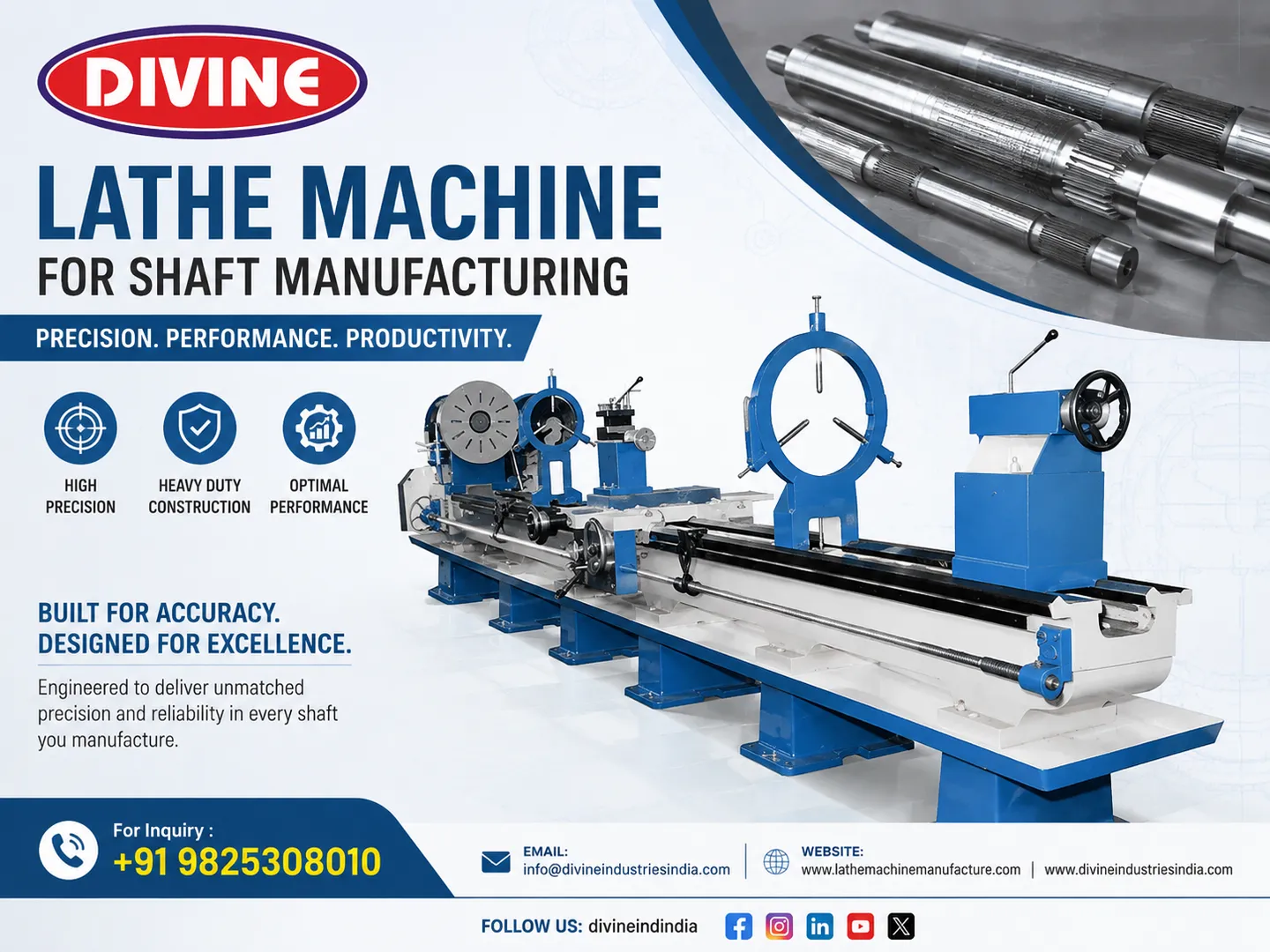
A lathe machine for shaft manufacturing is one of the most widely used machine tools for producing cylindrical shafts. It can perform operations such as turning, facing, threading, grooving, drilling, and chamfering to achieve the required shaft dimensions and geometry.
With the increasing demand for precision-engineered components, manufacturers are increasingly adopting CNC lathe machines for faster production, repeatability, and improved machining accuracy.
What Is a Lathe Machine for Shaft Manufacturing?
A lathe machine is a machine tool that rotates a workpiece around its axis while a cutting tool removes material from the workpiece.
For shaft manufacturing, the raw material—usually a metal bar or forged blank—is securely held in the machine. The cutting tool then moves along or across the rotating workpiece to produce the required diameter, length, shoulders, grooves, threads, and other features.
Depending on production requirements, manufacturers can use conventional engine lathes, heavy-duty lathes, or CNC turning machines.
Shaft Manufacturing Process Using a Lathe Machine
The typical shaft machining process involves several stages.
1. Material Selection
The first step is selecting the appropriate raw material. Common shaft materials include:
- Mild steel
- Carbon steel
- Alloy steel
- Stainless steel
- Tool steel
- Aluminium alloys
- Brass and other non-ferrous metals
Material selection depends on the shaft's strength, wear resistance, operating environment, and application.
2. Workpiece Setup
The raw shaft blank is mounted securely in the lathe chuck or between centers.
Correct alignment is extremely important. Improper setup can result in runout, dimensional errors, vibration, and poor surface finish.
3. Facing
Facing is generally performed at the beginning of machining to create a flat and accurate end surface.
This provides a suitable reference surface for subsequent operations.
4. Turning
Turning is the primary operation in shaft manufacturing.
During turning, the cutting tool travels along the length of the rotating workpiece and removes material to achieve the required diameter.
Different shaft sections can be machined to different diameters, creating stepped or tapered profiles.
5. Grooving and Parting
Grooves may be required for:
- Circlips
- Bearings
- Seals
- Retaining rings
- Snap rings
A grooving tool is used to create these accurately positioned features.
Parting can then be used to separate the finished shaft from the remaining material when required.
6. Threading
Many shafts require external threads for nuts, couplings, or other mechanical connections.
A lathe can produce precise external threads according to the required pitch and dimensions.
7. Drilling and Boring
A drill can be mounted in the tailstock or tooling system to create axial holes.
For larger or more precise internal diameters, boring operations can be performed.
8. Finishing and Inspection
After machining, the shaft is inspected for dimensional accuracy, concentricity, surface finish, and other specified tolerances.
Depending on the application, additional processes such as grinding, heat treatment, or polishing may be required.
Why Use a Lathe Machine for Shaft Manufacturing?
A properly selected lathe offers several advantages for shaft production.
High Dimensional Accuracy
Modern CNC lathes can maintain consistent dimensions across multiple components, making them suitable for precision shaft manufacturing.
Excellent Repeatability
Once a CNC program and tooling setup have been properly established, the same shaft profile can be reproduced repeatedly.
Faster Production
Automated tool movements and optimized cutting parameters can significantly reduce machining time compared with manual production.
Multiple Machining Operations
A single lathe setup can often perform several operations, including:
- Turning
- Facing
- Threading
- Grooving
- Drilling
- Boring
- Chamfering
This can reduce handling and setup time.
Better Surface Finish
The right combination of cutting tools, spindle speed, feed rate, depth of cut, coolant, and machine rigidity can produce a high-quality surface finish.
Applications of Lathe-Machined Shafts
Machined shafts are used across many industries, including:
- Automotive manufacturing
- Agricultural machinery
- Industrial machinery
- Pumps and compressors
- Gearboxes
- Electric motors
- Material handling equipment
- Construction machinery
- Textile machinery
- Power transmission systems
Shaft dimensions and machining requirements vary considerably depending on the application.
How to Choose a Lathe Machine for Shaft Manufacturing
Before purchasing a lathe, manufacturers should evaluate several factors.
Shaft Diameter and Length
The machine's swing diameter, maximum turning diameter, and distance between centers should accommodate the largest shaft being manufactured.
Machine Rigidity
Heavy-duty shaft machining requires a rigid machine structure to minimize vibration and maintain dimensional accuracy.
Spindle Capacity
The spindle bore and chuck capacity should match the raw material dimensions and workholding requirements.
Motor Power
Higher spindle power can be important when machining larger-diameter shafts or harder materials.
CNC Capabilities
For production environments, features such as automatic tool changers, programmable cycles, and bar feeding can improve productivity.
Accuracy and Repeatability
Select a machine capable of achieving the tolerances and surface finishes required for the final shaft.
Tips for Improving Shaft Machining Quality
To achieve consistent results, manufacturers should pay attention to:
- Proper workpiece alignment to reduce runout.
- Correct cutting-tool selection according to the shaft material.
- Optimized cutting speed and feed rate for the machining operation.
- Adequate workholding to prevent movement and vibration.
- Proper coolant or cutting fluid where appropriate.
- Regular machine maintenance to maintain accuracy.
- In-process inspection for critical dimensions.
- Tool wear monitoring to maintain consistent surface quality.
For long and slender shafts, additional support such as a steady rest or follow rest may be necessary to minimize deflection during machining.
The Future of Shaft Manufacturing
Modern shaft manufacturing is increasingly moving toward automation, CNC machining, digital measurement, and connected production systems.
Manufacturers are focusing on reducing cycle times while maintaining tight tolerances and minimizing material waste. CNC turning centers with automated workholding, tool monitoring, bar feeding, and integrated inspection can help manufacturers achieve these goals.
For companies producing shafts in larger quantities, investing in the right industrial lathe machine can improve productivity while delivering more consistent component quality.
Conclusion
A lathe machine for shaft manufacturing provides an efficient and versatile method for producing cylindrical and precision-engineered shafts. From basic turning and facing to threading, grooving, drilling, and finishing, a lathe can perform many of the operations required to manufacture shafts.
For low-volume and customized work, conventional lathes can offer flexibility. For high-volume production and demanding tolerances, CNC lathes provide automation, repeatability, and productivity advantages.
Choosing the right machine ultimately depends on shaft dimensions, material, production volume, tolerance requirements, and machining operations.
Looking for a reliable lathe machine for shaft manufacturing? Choose a machine designed around your shaft size, material, production requirements, and desired machining accuracy to achieve long-term productivity and consistent results.
Keywords