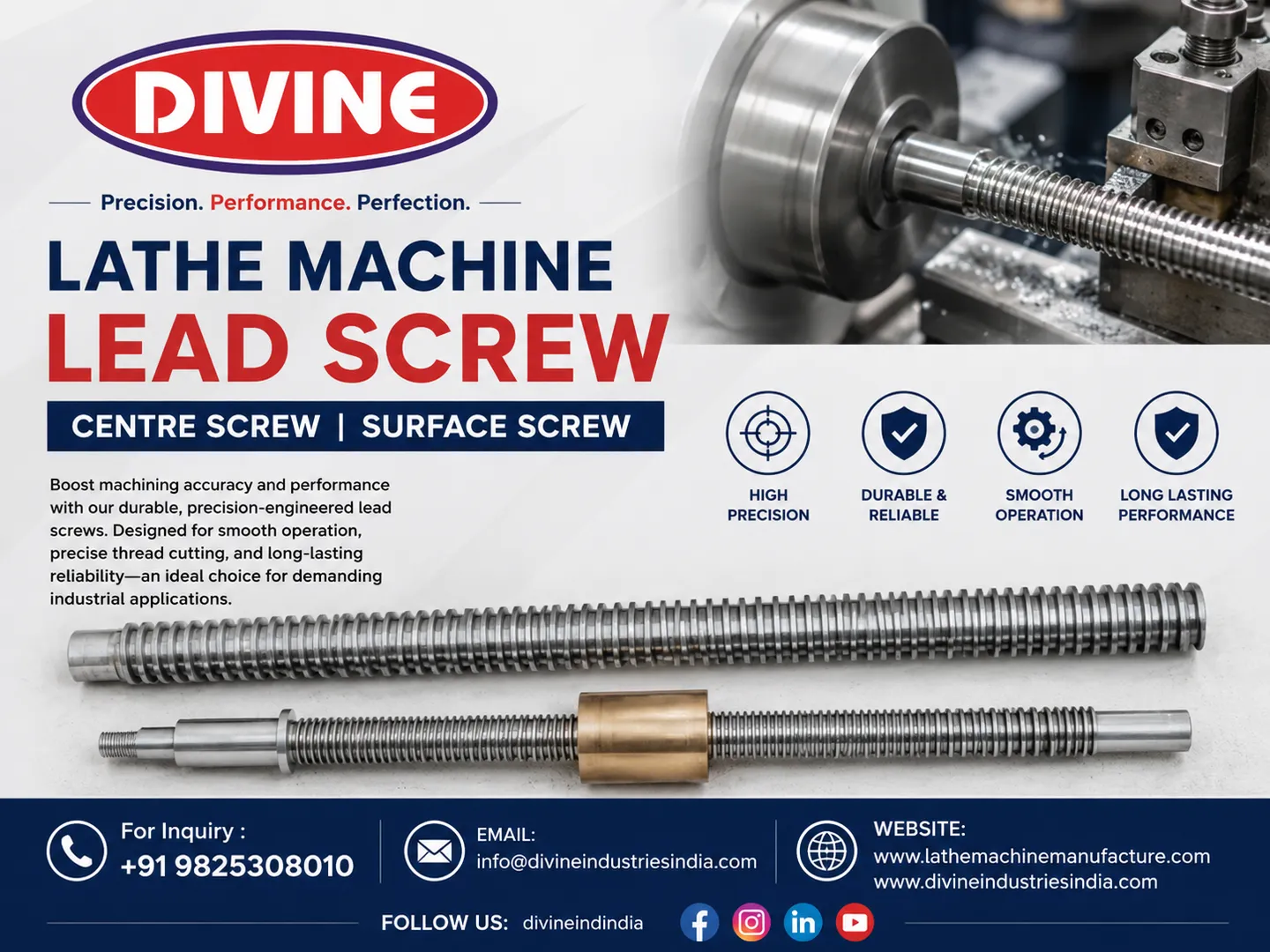
Lathe Machine Lead Screw, Centre Screw and Surface Screw Manufacturer
Lathe machines are an essential part of modern machining and metalworking industries. Their accuracy, performance, and service life depend greatly on the quality of the components used in their construction. Among these components, lead screws, centre screws, and surface screws play an important role in achieving smooth movement, proper alignment, and precise machining operations.
A reliable manufacturer focuses on accurate dimensions, high-quality raw materials, precision machining, and strict quality inspection to produce dependable lathe machine screws for different industrial applications.
What Is a Lathe Machine Lead Screw?
A lathe machine lead screw is a precision-threaded shaft that helps control the movement of the carriage during machining operations. It is particularly important when accurate and consistent thread cutting is required.
The lead screw transfers rotary motion into controlled linear movement. Its thread profile, pitch accuracy, surface finish, and dimensional consistency directly affect machining performance.
High-quality lead screws are generally manufactured using suitable alloy steel or other engineering materials selected according to the application and operating conditions.
Key Features of a Quality Lead Screw
- Accurate thread profile and pitch
- Excellent dimensional consistency
- Smooth surface finish
- High wear resistance
- Good mechanical strength
- Reliable performance during continuous operation
- Proper alignment and concentricity
Centre Screw for Lathe Machines
The centre screw is another important precision component used in machine tools. It is designed to provide secure fastening, positioning, or controlled movement depending on the machine design.
Manufacturing centre screws requires careful control over dimensions, threading, hardness, and surface quality. A properly manufactured screw helps maintain stability and reliable operation during machining.
Industrial buyers often select centre screws based on the machine model, thread specifications, material requirements, and application.
Surface Screw Manufacturing
Surface screws are manufactured for applications where accurate fitting, secure fastening, and dependable surface contact are required. Their performance depends on factors such as material quality, thread accuracy, machining precision, and finishing.
A professional screw manufacturer uses controlled production processes to maintain consistency from one component to another. This is particularly important for replacement parts and components used in precision machinery.
Manufacturing Process of Lathe Machine Screws
Producing a precision lathe machine screw involves several stages. Each stage contributes to the final accuracy and performance of the component.
1. Selection of Raw Material
The manufacturing process begins with selecting suitable raw material. Material selection depends on factors such as load, operating conditions, required hardness, wear resistance, and intended service life.
2. Cutting and Turning
The raw material is cut to the required length and machined to achieve the specified outside diameter. Precision turning helps establish the basic dimensions of the screw.
3. Thread Cutting
Thread cutting is one of the most critical operations. The required thread pitch, diameter, profile, and length must be maintained accurately to ensure proper compatibility with the mating component.
4. Heat Treatment
Depending on the application, heat treatment may be carried out to improve hardness, strength, wear resistance, and durability.
5. Surface Finishing
Grinding, polishing, or other finishing processes may be used to achieve the required surface quality. A smooth and consistent surface can help reduce friction and improve operating performance.
6. Quality Inspection
The finished screw is inspected for dimensions, thread accuracy, straightness, concentricity, surface finish, and other specified parameters before dispatch.
Why Precision Matters in Screw Manufacturing
Small dimensional variations can affect the performance of a machine tool. An inaccurately manufactured lead screw, for example, can influence carriage movement and thread-cutting accuracy.
For this reason, professional manufacturers pay close attention to:
- Thread pitch accuracy
- Diameter tolerance
- Straightness
- Concentricity
- Surface finish
- Hardness
- Material quality
- Overall dimensional accuracy
Precision manufacturing helps improve compatibility, reduce premature wear, and support dependable machine performance.
Applications of Lathe Machine Screws
Lead screws, centre screws, and surface screws can be used in various machine-tool and industrial applications, including:
- Lathe machines
- Conventional machine tools
- Precision machining equipment
- Metalworking machinery
- Industrial repair and maintenance
- Replacement machine components
- Engineering workshops
- Customized machinery
Choosing the Right Lathe Screw Manufacturer
When purchasing precision screws, selecting the right manufacturer is important. Buyers should consider manufacturing capabilities, machining technology, quality-control systems, material options, dimensional accuracy, and customization facilities.
A dependable manufacturer should be capable of producing components according to specific drawings, dimensions, thread profiles, and application requirements.
Custom Lathe Machine Screw Manufacturing
Every machine does not necessarily use the same screw specifications. Therefore, manufacturers may provide customized solutions based on customer requirements.
Custom manufacturing can include:
- Different screw lengths
- Customized diameters
- Various thread pitches
- Special thread profiles
- Different materials
- Specific hardness requirements
- Customized surface finishes
This makes precision screw manufacturing suitable for both standard replacement requirements and specialized industrial machinery.
Benefits of High-Quality Lathe Machine Screws
Using properly manufactured screws can provide several advantages:
- Improved machine movement
- Better machining accuracy
- Longer component life
- Reduced wear
- Reliable thread engagement
- Better operational consistency
- Reduced maintenance requirements
Conclusion
Lathe machine lead screws, centre screws, and surface screws are important precision components for machine tools and industrial equipment. Their quality directly influences movement, alignment, fastening, and machining performance.
From raw-material selection and precision turning to thread cutting, finishing, and inspection, every manufacturing stage must be carefully controlled. Choosing an experienced lathe machine screw manufacturer can help industries obtain durable, accurate, and application-specific components for their machinery.
For businesses looking for reliable lead screw, centre screw, and surface screw manufacturing, working with a manufacturer that emphasizes precision engineering and quality control can be an effective way to achieve consistent machine performance.
Keywords